
One of the most frequent clinical questions asked in our operatory at Dental Planet Mysore is straightforward: "Doctor, does an electric toothbrush actually make a difference, or is it just clever marketing?"
As specialists in periodontics and orthodontics, we base our recommendations strictly on scientific evidence rather than commercial trends. In this comprehensive review, we examine the landmark Cochrane systematic reviews, hydrodynamic plaque disruption, and how powered toothbrushes safeguard dental implants, receding gums, and orthodontic appliances.
The Scientific Verdict: Cochrane Systematic Review Data
When evaluated in peer-reviewed clinical trials, the numbers speak clearly. The authoritative Cochrane Oral Health Group evaluated over 50 randomized controlled trials involving more than 5,000 subjects comparing manual and powered toothbrushes:
- 21% Greater Plaque Reduction: At three months of consistent use, powered toothbrushes removed significantly more supragingival biofilm than manual brushes.
- 11% Reduction in Gingival Bleeding: Clinically measured gingivitis scores and papillary bleeding upon probing decreased noticeably when switching to a powered device.
- Consistent Compliance: The built-in 2-minute quadrantal timer ensures patients actually brush for the full scientifically recommended duration (the average adult with a manual brush stops after just 46 seconds).
Oscillating-Rotating vs. Sonic Technology: What Is the Difference?
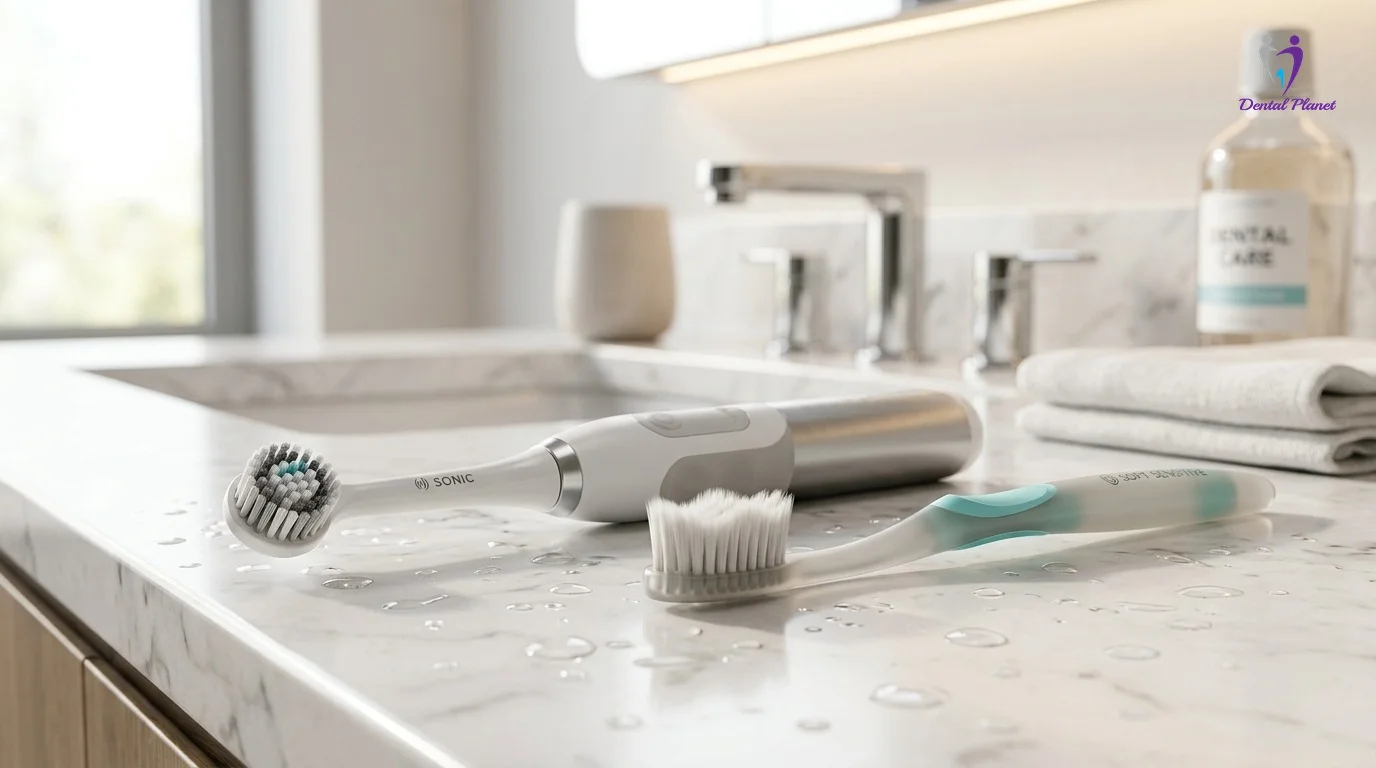
Not all electric brushes operate on the same mechanical principles. The dental literature categorizes powered brushes primarily into two proven modalities:
| Mechanism | Action Velocity | Biological Benefit | Best Suited For |
|---|---|---|---|
| Oscillating-Rotating (Round Head) | ~8,800 oscillations / 40,000 pulsations per min | Surrounds each individual tooth; micro-pulsations fracture calcified plaque margins. | Crowded lower anterior teeth, heavy calculus formers, lingual surfaces. |
| Sonic Fluid Dynamics (Acoustic) | ~31,000 to 62,000 acoustic brush strokes per min | Generates dynamic fluid micro-bubbles that penetrate 3–4 mm into interdental spaces and subgingival pockets. | Dental implant crowns, delicate gum recession, patients in active Invisalign or ceramic braces. |
Why Dental Implants Require Specialized Plaque Control
Unlike natural teeth, which are suspended in alveolar bone by the shock-absorbing periodontal ligament and rich collagen fibers (Sharpey's fibers), dental implants are anchored via rigid osseointegration.
"Around an implant, the mucosal cuff is more fragile and vulnerable to bacterial invasion. If plaque bio-crusts accumulate along the crown-abutment margin, it triggers peri-implant mucositis. Left unchecked, this advances to peri-implantitis with progressive bone loss. Sonic toothbrushes create non-contact acoustic hydrodynamic turbulence that flushes biofilm out of subgingival margins without scratching high-polish zirconia or titanium collars."
Protecting Receding Gums: The Power of Pressure Sensors
Many patients believe that brushing harder makes teeth cleaner. In reality, aggressive horizontal scrubbing with a hard or medium manual toothbrush is the leading cause of cervical abrasion (wedge-shaped notches at the gumline) and gingival recession.
Premium powered toothbrushes incorporate smart tactile pressure sensors. If you apply greater than 2 to 2.5 Newtons of pressure, the brush handle vibrates, flashes an LED ring, or automatically throttles its motor speed, preventing mechanical trauma to thin gingival biotypes.
Clear Aligners & Orthodontic Braces Hygiene
Dr. Bhagyalakshmi Avinash emphasizes that during orthodontic tooth movement, maintaining spotless enamel is vital:
- Invisalign Attachments: Composite buttons bonded to enamel create tiny plaque shelves. High-frequency brush bristles effectively sweep around attachments without abrading composite resin.
- Interproximal Cleaning: As crowded teeth uncross and de-rotate, newly exposed proximal surfaces require thorough biofilm removal to prevent interproximal white spot lesions.
Experience Computerized 3D Smile & Oral Health Diagnostics
Curious about your periodontal biotype, gum margins, or considering orthodontic alignment? Book your comprehensive assessment at Dental Planet Mysore.
October VIP Pass: Complimentary 3D iTero Digital Scan (Valued at ₹3,500) + ₹10,000 Invisalign Treatment Credit (Strictly 12 Slots).
Claim VIP Pass on WhatsAppFrequently Asked Questions (FAQ)
Q1: Does scientific evidence prove electric toothbrushes clean better than manual brushes?
Yes. Independent Cochrane Systematic Reviews covering over 5,000 subjects demonstrate that powered toothbrushes—especially oscillating-rotating and sonic designs—reduce dental plaque by 21% and gingival inflammation (bleeding) by 11% compared to manual toothbrushes over a 3-month period.
Q2: Can an electric toothbrush cause gum recession or enamel wear?
No, provided it features a built-in pressure sensor and soft bristles. In fact, most enamel wear and cervical abrasion in adults stems from over-vigorous horizontal scrubbing with stiff manual toothbrushes. Premium electric brushes automatically slow down or flash red when excessive force is applied, protecting thin gingival biotypes.
Q3: Are electric toothbrushes safe for dental implants and crowns?
Electric toothbrushes are highly beneficial for dental implants. Peri-implant tissues rely on a delicate mucosal seal rather than a periodontal ligament. Sonic fluid dynamics help dislodge sticky anaerobic biofilms from implant abutment margins without scratching titanium surfaces, dramatically reducing the risk of peri-implant mucositis.
Q4: Which is better during Invisalign or orthodontic braces?
While Invisalign aligners are removed during brushing, teeth fitted with orthodontic attachments or traditional fixed brackets accumulate plaque at high-risk retention zones. Sonic micro-movements reach proximal line angles and interdental areas far more effectively than manual scrubbing, keeping enamel pristine throughout treatment.
Q5: What is the October VIP Invisalign & Oral Health Assessment at Dental Planet Mysore?
During October 2026, Dental Planet Mysore provides an exclusive VIP Pass including a complimentary 3D iTero optical scan and outcome simulation (valued at ₹3,500) plus a ₹10,000 Invisalign treatment credit, strictly capped at 12 patient consultation slots.